

How to Process Emotions: A 6-Step Guide for Every Age and Stage (with a Feeling Wheel)
If I had a dollar for every time someone sat down in a counselling session and started with “I’m fine,” I could probably buy Kelowna a new bridge.
Most of us were taught to manage our emotions. Be polite. Don’t make a scene. Push through. Very few of us were taught to understand our emotions, let alone what to do with them.
That’s true whether you’re six or sixty. A child melting down in the grocery store, a teenager going quiet at dinner, a university student lying awake before exams, a couple having the same argument for the hundredth time: underneath it all is usually an emotion that hasn’t been heard yet.
Here’s what I’ve learned as a counsellor, clinical supervisor, and mom: emotions aren’t the enemy. They’re messengers. When we learn to listen, they come, they deliver their message, and they go.
What Is Emotional Processing?
Emotional processing is how a feeling moves through you instead of getting stuck in you. It means noticing the emotion in your body, naming it, accepting it without judgment, understanding what it’s telling you, responding in line with your values, and letting it go.
When emotions don’t get processed, they pile up. You might notice snapping over small things, feeling flat or exhausted, lying awake replaying conversations, or reaching for your phone, food, or work to avoid a feeling. That doesn’t mean something is wrong with you. It usually means your emotions have been sending messages that haven’t been received yet.
Emotional Processing vs. Emotional Regulation
These two work as a team.
Emotional regulation turns the volume down. It’s slowing your breathing, stepping away for a minute, or grounding yourself so you can think clearly.
Emotional processing goes deeper. It’s understanding what the feeling is telling you and deciding what to do about it.
Think of a smoke detector. Regulation is waving the tea towel so the alarm stops blaring. Processing is checking whether something is actually burning.
How to Process Emotions in 6 Steps
- Feel
- Name
- Accept
- Process
- Respond
- Let go
Step 1: Feel
Your body almost always knows first. Pause and get curious:
- Where is it in my body? A tight chest, a clenched jaw, a knot in your stomach, heat in your face?
- Is my body revving up? A racing heart, shallow breathing, and tense muscles are signs of your sympathetic nervous system, your “fight or flight” response, getting ready to protect you.
- Have I felt this way before? When? What was happening?
- What does it look like? If it had a colour, shape, or size, what would it be?
- What does it feel like? Heavy or light, hot or cold, still or buzzing?
You’re not fixing anything yet. A few slow breaths with a longer exhale can help you settle enough to notice.
Step 2: Name
You can’t work with what you can’t name. Ask most people how they feel and you’ll hear “good,” “fine,” “stressed,” or “mad.”
Six core emotions show up across cultures: anger, sadness, fear, disgust, surprise, and happiness.
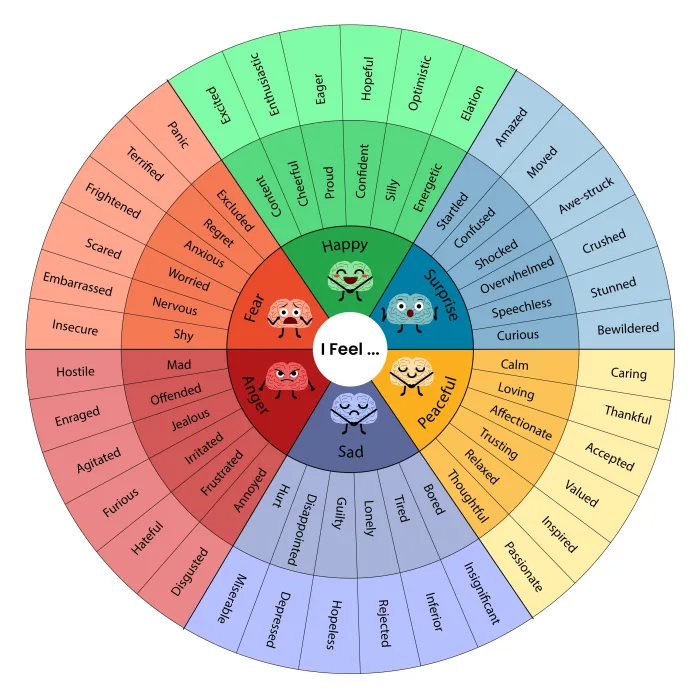
A feeling wheel helps in two directions:
- Moving inward: Feeling a swirl of things? Narrow it down to the core. “Overwhelmed” and “insecure” might both lead back to fear.
- Moving outward: Only have the core word? Find more precise language. “Angry” might really be frustrated, disrespected, or betrayed.
| Core emotion | More specific words |
|---|---|
| Anger | frustrated, irritated, resentful, disrespected, jealous, betrayed |
| Sadness | lonely, disappointed, hurt, grieving, discouraged, empty |
| Fear | anxious, insecure, overwhelmed, nervous, worried, rejected |
| Disgust | disapproving, repulsed, uncomfortable, judgmental, appalled |
| Surprise | startled, confused, amazed, shocked, curious |
| Happiness | joyful, proud, grateful, content, hopeful, peaceful |
For younger children, a feeling chart with faces works beautifully. Pointing to a face is often easier than finding the words.
Dr. Dan Siegel calls this “name it to tame it,” and research backs it up. A UCLA study led by Dr. Matthew Lieberman found that putting feelings into words can calm the brain’s alarm system. I think of it as giving your feeling a name tag so it stops running around the party unsupervised.
Step 3: Accept
This is the step most of us skip. We judge our feelings before we’ve finished feeling them. I shouldn’t be this upset. I’m being dramatic. Other people have it worse.
But no emotion is good or bad. Emotions are simply your body trying to give you information. Your job isn’t to grade the feeling. It’s to listen to it.
Back to that smoke detector: you’d never yell at it for going off. You’d go see what’s happening in the kitchen.
Try saying: “It makes sense that I feel this way.”
Step 4: Process
Now listen. Every core emotion carries a core message:
| Emotion | What it’s trying to tell you |
|---|---|
| Anger | Something is not fair or just. You’re not being treated the way you feel you deserve. |
| Sadness | You have lost, or are losing, someone or something that matters. |
| Fear | There is danger present (or your body believes there is). |
| Disgust | You want to reject something. |
| Surprise | Something unexpected has happened. |
| Happiness | Things are going well. |
When I called neighbours here in the Okanagan who had lost their homes in wildfires, so many apologized for crying “over a house.” But sadness was doing exactly its job. It was telling them they had lost something that mattered: the height marks on the door frame, the Sunday mornings, the sense of safety.
Then go a layer deeper:
- What thoughts come with this emotion? “They don’t respect me.” “I’m going to fail.” Notice them without automatically believing them.
- What behaviours come with it? Do you shut down, snap, scroll, overwork, or avoid?
Seeing the feeling, thoughts, and behaviours side by side helps you spot your patterns, and patterns can change.
Step 5: Respond
Ask yourself:
- What is this emotion asking me to do?
- What gift does it have for me?
- How can I respond in a way that reflects my values?
Anger might be asking you to set a boundary. Sadness might be asking you to slow down and let people care for you. Fear might be asking you to prepare, or to check whether the danger is real. Happiness might be asking you to savour the moment.
Your response can be practical, like having a conversation, apologizing, asking for help, or saying no. It can also be creative: journaling, painting, a walk along the lake, music, or a letter you never send.
Step 6: Let Go
Once you’ve responded, the emotion has done its job. So say thank you, and let it go.
If it comes back, it may have a new message for you, and now you know how to listen.
Emotional Processing at Every Age and Stage
The six steps work for everyone, but they look a little different depending on where you are in life.
Children
Your six-year-old falls apart when screen time ends. Instead of “Stop crying, it’s just a show,” try getting down to their level and pointing to the feeling chart together. “You look disappointed. You were really enjoying that.” Once they feel understood, their body calms, and you can help them choose what comes next. Kids learn to regulate by borrowing our calm first.
Teens
Your teen sees photos of friends hanging out without them and spends the evening in their room. That’s sadness and fear: I’ve lost my place, and I might not belong. Teens often need us to name it gently without lecturing: “That would sting. Want to talk, or want company?” The respond step might be texting one friend, or simply not posting anything at midnight.
University and College Students
First semester away from home, and a student who loved high school suddenly feels homesick and anxious every Sunday night. Naming it helps: lonely and overwhelmed, rooted in sadness and fear. Responding might look like calling home, joining one club, or booking a session with campus counselling. Big transitions are supposed to feel big.
Athletes
An athlete makes a mistake late in a big game and replays it for days. Unprocessed emotions don’t stay in the dressing room. They show up as tight muscles, rushed decisions, and negative self-talk. Feeling, naming, and responding with a reset routine helps athletes let the moment go and get back to their game.
Parents
It’s 5 p.m., dinner isn’t made, everyone needs something, and you snap. That flash of anger is often a message that your own needs have gone unmet all day. Accept it without shame, take two minutes in another room, and respond with what you need, whether that’s help, a snack, or a quiet bath after bedtime. Then repair with your kids. Repair teaches them more than perfection ever could.
Adults
The Sunday-night dread before a work week creeps in. Fear at the core, with overwhelmed and unappreciated in the outer ring. What is it asking for? Maybe a plan for Monday morning, a boundary with a coworker, or an honest look at whether this job still fits your values.
Couples
The same argument about dishes comes up again and again, but it’s rarely about dishes. Underneath the anger is often hurt or unappreciated, and underneath that, a fear of not mattering to each other. Sharing the softer feeling (“I feel alone in this”) instead of the sharp one (“You never help”) changes the whole conversation. This is the heart of Emotionally Focused Therapy (EFT), one of the most researched approaches for couples.
Families
Families can process emotions together too. Try a weekly check-in at dinner where everyone points to one feeling on the wheel from their week. Approaches like Emotion-Focused Family Therapy (EFFT) show how powerful it is when parents become emotion coaches for their children. When feelings become normal to talk about, kids grow up knowing what to do with them.
When to Reach Out for Support
Some emotions are too big, too old, or too tangled to sort out alone, and that’s okay. If you keep getting stuck at the same step, if your emotions are affecting your sleep, relationships, school, or work, or if “I’m fine” has become a full-time job, counselling can help.
At Alive Counselling in Kelowna, we believe the right fit is the most important part of counselling. Our team supports children, teens, students, adults, couples, families, and athletes.
If you’re in crisis or having thoughts of ending your life, call or text 9-8-8 any time, or go to your nearest emergency department.
Outside of BC? Through Alive Coaching Group, I offer online mental health and mental performance coaching across the US and Canada, plus online counselling for Tennessee residents. Visit Alive Coaching Group.
Frequently Asked Questions
How do you process emotions?
Notice where the emotion shows up in your body, name it using a feeling wheel, and accept it without judgment. Ask what it’s trying to tell you, respond in a way that fits your values, and let it go.
How can I help my child process emotions?
Stay calm yourself, name the feeling you see, and validate it before problem-solving. A feeling chart with faces helps younger children point to what they feel.
What is the difference between emotional processing and emotional regulation?
Emotional regulation lowers the intensity of an emotion so you can think clearly. Emotional processing helps you understand what the emotion means and respond to it.
How can couples process emotions together?
Share the softer feeling underneath the conflict, such as hurt, fear, or loneliness, rather than the sharp one. Listening without fixing helps partners feel understood.
What is a feeling wheel?
A feeling wheel is a visual tool with core emotions in the centre and more specific feeling words around them. It helps you name exactly what you feel.